

Quantitative proteomics in your own hands – from experiment design to data analysis
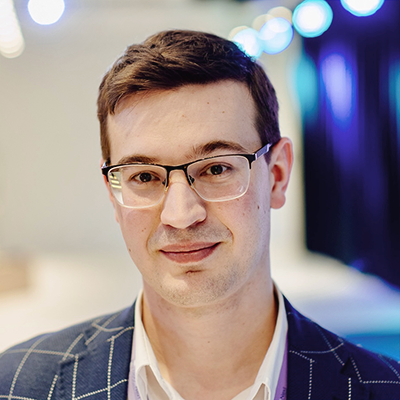
Oleksandr Hubar
In this lecture of the BioGENext Series, Oleksandr Hubar delivered a comprehensive, practice-oriented overview of modern quantitative proteomics, guiding participants through the full workflow from experimental design to biological interpretation of results. The lecture addressed key principles of proteomic experiment planning:
- selection of appropriate quantification strategies with an emphasis on label-free quantification (LFQ)
- reporter ion–based approaches as well as definition of sample sets and replication strategies.
He discussed critical aspects of sample preparation, such as cell lysis, protein digestion, and peptide clean-up, highlighting common pitfalls and optimization strategies.
Particular attention was given to mass spectrometry system parameters that strongly influence data quality and to the rationale behind their correct configuration. A central component of the lecture was a live demonstration of an end-to-end data analysis pipeline, starting with retrieval of publicly available raw datasets from the PRIDE/ProteomeXchange repository, followed by database searching and quantification using MaxQuant, quality control with PTXQC, and basic statistical analysis and biological interpretation in Perseus.
Overall, the lecture equipped participants with a clear understanding of how to design, execute, and critically evaluate quantitative proteomics experiments, including effective reuse of public datasets and informed interpretation of proteomic data in a biological context.